Search This Blog

Showing posts with label Social Science. Show all posts

The European Union Study Plan

We will proceed as follows:

Finish all exercises in the book online - 2 points
Do #1 and #4 for an extra point.
Or do a summary with pictures for an extra point.
Presentation: 2 points
Kahoots - total of 4
Quizzes: 1 point each, total of 2

Total points - 10 points

PRESENTATIONS: COPYING IS NOT ALLOWED. If you have copied and pasted from the Internet, your presentation will be rejected! Deadline for all presentations: May 22 May 28 June 2
NO COPYING? What can you do?

  • Choose a country in the European Union. (You can use the country you presented in Unit 2) Tell us about its capital city, population, and government. Is it in the Eurozone? 
  • Tell us about news of Europe, a current event, an event in the twentieth century, in your own words. Reference your sourcesNo copying is allowed!


All online book exercises: May 28 June 8

Time Schedule - 
May11-15  Play Kahoot May 13, choose a presentation and send your request in to teacher.
May 18-22 Section 1 and Section 2
May 25-28 Sections 3 
June 1 - 4 Finish all presentations and quizzes
June 9-11 Finish all quizzes


Main Points
Section 1 - The aims and history of the European Union 
Seciton 2 - The EU's institutions
Section 3 - The single market and the Eurozone

Spain's Political System - Study plan

We will proceed as follows:


Presentation 30%
You must choose a presentation from the list of main points. 
I have included here different experiments for this unit. 
Choose one and send me your choice by Friday, March 20. 
To share it with the class, you must send a document, photo 
or a PowerPoint presentation to my email by March 23 March 27. 

Notebook 20%
Read the unit and make a front page listing the objectives. 
Make an entry in the table of contents in your notebook.
Make a summary, draw pictures with some explanation marking 
the main points, or complete the exercises written below as we 
have been doing in class. 
This counts for 20% of your mark for the unit. (It used to be 30%). 
You and your parents will grade your notebook as we do in class, 
checking the main points on the list and in your notebook. 
Notebooks must be finished and graded by March 27 April 2.

page numbers and exercises 
p88 - #1
p89- #2, 4
p90 - #1
p91- #2, 4
p94 - #1
p95  #2, 4
p98-  #1, 2
p99 - #5, 6, 7, 8
p100 -#1

Final Exam 50%
This will be on April 2 April 16 April 22 April 24I will create a study guide and post it on this blog before that.

Spain's Political System Students' Presentations

You have done an excellent job on your presentations. 
Well done!


If you send them in late, they will appear later. 


Spain's Political System presentations pending

Presentations pending of this unit

Democracy by Matthew Fernández
Democracy by Luis Nepomuceno


Constitution of 1978, Constitution Day by Óscar Bilbao
Constitution of 1978 by Nadia Calleja


Rights and Responsibilities by Lucía López
Rights and Responsibilities by Aitor Martín completed


Elections by Itziar Pérez


Separation of power by Álvaro París
Separation of power by Jesús Quíros
Separation of power by Sara Riquelme


executive branch by Emilia Gaspar
executive branch by Noemí Berzal
executive branch by Anaís Martínez


legislative branch by Jimena Moreno
legislative branch by Gabriel Cloanta


judicial branch by Paula Hernández


absolute majority 
coalition government by Clara Ainhoa García


minority government


Prime Minister or President? by Hector Afonso


State of Emergency by Carla Martín


Public Services by Irene Mateo
Public Services  by Asier González
                                  Public Services  by Paula Acevedo
                                  Public Services  by Mencía Martínez
Public Services  by Aitor Iglesias

Local councils


National government by Aitana Rodríguez


Autonomous communities by Óscar Budeanu


Taxes in Spain and VAT by Lucía Trejo
Taxes in Spain and VAT by Aitana Sanz
Taxes in Spain and VAT by Sofía Bouhad
Taxes in Spain and VAT by Emilia Gaspar
Taxes and VAT by Leonard Pijen

Budget by Davíd Martín-Maestro Fernández


Protección Civil by Sofía Martín

Kahoot by Blanca Herrero


Spain's Political System - main points and audio book


Download audio files here


Main points of this unit

Democracy
Constitution of 1978, Constitution Day
Rights and Responsibilities
Elections
Separation of powers 
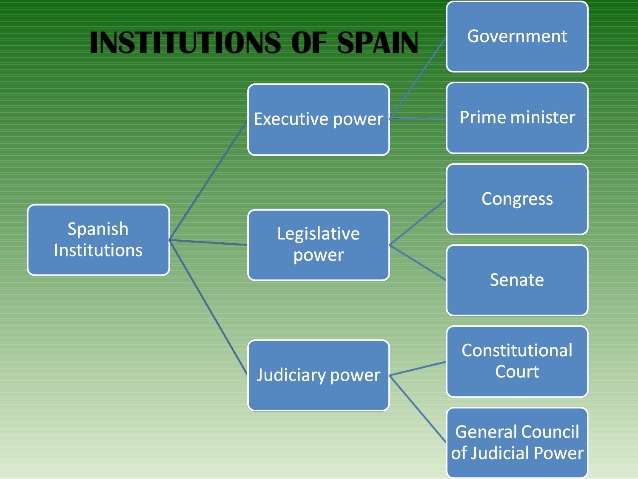
executive branch
legislative branch
judicial branch
absolute majority
coalition government
minority government
Prime Minister or President?
State of Emergency (look it up on THIS PAGE.)
Public Services
Local councils
National government
Autonomous communities
Taxes in Spain and VAT

Modern Spain in the 20th Century


Read the Unit once (1 time) from beginning to end.


  • Make a Frontpage for the unit and copy the objectives
  • Read each section again carefully. 
  • Write the name of each section and the main points. 


Make a mindmap, or a summary and a timeline, or answer the questions 1,2 and 3 in the book, or
write a story or comic for each main point 
in your notebook. It must make sense to you. 
(Read the book, find information in Spanish, 
ask your family members what they know, look for videos on Youtube.)
Record an entry in the TABLE OF CONTENTS. 
This is worth three points.


Present the main point or create an activity for the class. 
This is worth two points.  

Presentations by February 21st (Thanks Yanira😊)
Notebooks must be finished by 
Thursday, February 27th (thanks Jesús😁).
They won't (will not) be accepted after this date.
Turn them in as soon as you are finished. 
**EXAM Wednesday, MARCH 4**

Ideas: Section 1 Spain in the early 20th century
Main Points
Restoration 1874 to 1923
Primo de Rivera
Second Republic
Liberals and Conservatives
Republican parties and Nationalists parties
Socialist Party
Left-Wing people and Right-Wing people

Section 2 The Spanish Civil War
Main Points
Spanish Civil War
and its consequences

General Francisco Franco

Dictatorship


Section 3 Spain during Franco's dictatorship
Main Points
Falange, Catholic Church, The Military

Trade Unions during the dictatorship

living conditions during the 1940s and 1950s

Second World War
United Nations and Spain's exclusion

Section 4 Spain since 1975
Main Points 

Adolfo Suarez
The transition
Democracy in Spain
Spanish Constitution
Military coup of 1981 by Antonio Tejero
Economic European Community (EEC)
Spain's currency


Section 5 Art and Culture in 20th century Spain
Main Points
Spanish artists of the 20th century


Carta para los padres Social Science: Europe


Social Sciences 6º                                                  Unidad 2


Queridos madres y padres: Vuestro hijo o hija va a comenzar la unidad 2 de su libro de Ciencias Sociales Oxford New Think Do! Learn 6. Esta unidad tiene por título Europe (“Europa”), y en ella aprenderá:


·         Los diferentes territorios que comprenden Europa. Las zonas horarias que tiene cada zona del continente.

·         Los principales ríos y lagos que se encuentran en Europa y datos importantes de los mismos.

·         Las características propias del relieve de Europa.

·         Los elementos que conforman el litoral de Europa; penínsulas, archipiélagos, cabos, golfos, bahías e islas.
 

Os adjunto el vocabulario más importante que aprenderá a lo largo de la unidad.Quisiera animaros a que ayudéis a vuestro hija o hijo a interiorizar los contenidos utilizando la presentación con diapositivas y las actividades de Let’s play! ubicados la Plus Zone. Asimismo, os invito a localizar en un atlas los diferentes ríos europeos con vuestros hijos, así como las cordilleras más importantes. Tu hija o hijo tendrá que presentar un país de la unión Europeo donde tiene que incluir información descrito en la página treintaicuatro de su libro. Si necesita recursos para terminar el proyecto los puede pedir en clase.
Sin duda, vuestra colaboración ayudará a que vuestro hijo o hija aprenda y se divierta.Saludos,Monica Carter


Europe      Unidad 2(Europa)

Lista de vocabulario

Alps = Alpes

Apennines = Apeninos

archipelago = archipiélago

Arctic Sea = Mar Ártico

Atlantic Ocean = Océano Atlántico 

Balearic Islands = Islas Baleares

Balkan Peninsula = Península balcánica 

Baltic Sea = Mar Báltico

basin = cuenca

Bay of Biscay = Golfo de Vizcaya

Black Sea = Mar Negro

Canary Islands = Islas Canarias

Caucasus = Caúcaso

cape = cabo

Carpathian Mountains = Montes Cárpatos

Crimean Peninsula = Peninsula de Crimea 

Cyprus = Chipre

Denmark = Dinamarca 

depression = depresión 

Elbe = Elba

English channel = Canal de la Mancha

euro = euro 

fjords = fiordos 

glacier = glaciar

Greenland = Groenlandia

gulf = golfo

Iberian Peninsula = Península ibérica

Iceland = Islandia

inlet = entrada

Ireland = Irlanda

island = isla

Italian Peninsula = Península itálica

Land’s End = Finisterre

Loire = Loira

Mediterranean Sea = Mar Mediterráneo

navigable = navegable 

North Sea = Mar del Norte 

Oder = Óder

Peloponnese Peninsula = Península del Peloponeso

rainfall = precipitación 

Rhine = Rin

rias = rías

Scandinavian Peninsula = Península escandinava

Seine = Sena

Thames = Támesis

time zone = zona horaria

Urals = Urales

Vistula = Vístula


Civics Extra - Forms of Government

Watch this video and learn about the types of governments there are.

Make a list in your Social Science notebook in Spanish Rights and Responsibilities. Take notes on the right side of the spiral. Label it Forms of Government  It will be on the exam later. 👋


Spanish Rights and Responsibilities

Look at this SITE.


CLICK HERE to read the Spanish Constitution.

 Answer These Questions.
 
  1. What are rights? Write the definition in your notebook.
  2. What are responsibilities? Write a definition in your notebook.
  3. How many parts does the Spanish Constitution have?
  4. Which part are the rights in?
  5. What does Section 14 say? Copy it in your notebook.
  6. What does discrimination mean?
  7. What does circumstance mean?
Copy DIVISION 1.ª Fundamental Rights and Public Freedoms
    • Sections 15 to 29 (copy only the first line of each Section)
Copy DIVISION 2.ª Rights and Duties of Citizens
    • Sections 30 to 38 (copy only the first line of each Section)
CHAPTER V Suspension of Rights and Freedoms
8. What does suspension mean in this title?
    • Copy Section 55 in your notebook. 
  Unwarranted or_____________ of the powers recognized in the foregoing organic act shall give rise to criminal liability as a violation of the rights and freedoms recognized by the laws.